
Welcome
Welcome to The Sleeping Almanac. Tonight, how they came back. Last time we sat in a round church in the rain and took the books down off a shelf one at a time, the Book of Enoch and the angel with the tablet and the giants who dreamed and the gospel with no story in it, and I told you how Enoch and Jubilees were kept in an Ethiopic scriptural inheritance. Tonight I want to tell you about the other countries. About a Scotsman who walked out of the mountains with three books in his luggage and whose travels met both interest and ridicule.
About a shepherd, and a cliff, and a jar, and a smell of old leather in the dark. About a later Egyptian account of a farmer digging for something to put on his fields, and what his spade hit. About a room full of fragments the size of postage stamps, and a scholar remembered for his work fitting pieces together. And about a cave where, when the scraps were finally laid out and read, ancient pieces of the book on the copyist's knees could be compared with his inheritance. Stay with me down to the fifth chapter for that.
It is the thing the whole night is for. And then, when everything has been dug up and unrolled and read, I am going to tell you why the word we have been using for two nights is the wrong word, and I think you will already know by then. There is a church at the top of a hill, and inside it there is a lamp. If you were here last time, you know it. If you were not, you are welcome, and you have missed nothing you cannot be told in a breath.
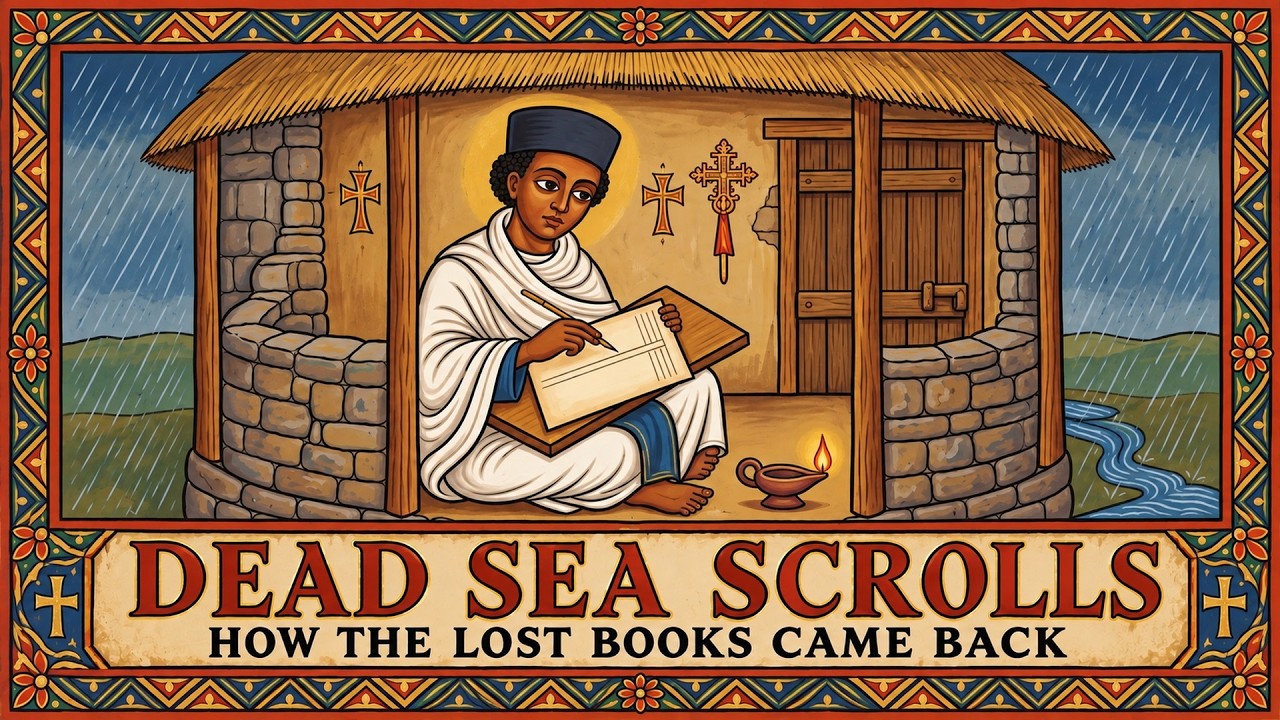
The church is round and its roof is thatch and it is raining on it, the long soft rain of the highlands, the same rain, and by the lamp there is a man in white with a board across his knees and a sheet of parchment on the board, and on the parchment, in two columns, in black ink and a little red, there is a book that he is copying. The book is the Book of Enoch. And the whole of last night was this: that the world says that book was lost, and this man has never heard that, because on this hill it never was. His teacher copied it, and his teacher's teacher, and the rain fell on all of them, and nobody was ever told to stop. That is where we left him.
He has a new leaf on the board tonight. The old one dried, and it was good, and it is with the others now. He rules the new one with a blunt point, pressing the ghost lines into the skin, two columns, every line waiting, and he dips the reed. There is a place for you here, the same place, in the warm part of the room. The mat, the folded cloth, the whole night with nothing in it that you must carry.
You do not have to do anything now. But tonight, before he begins, I want to ask him a question, and it is the question of the whole night. Last time I told you the book was never lost here. Its full text was preserved in the Ethiopic tradition. But here is a small hill in a large world.
What about the older witnesses behind his book? Much of Enoch was written in Aramaic, an ancient language widely used in the Near East. The Ethiopic version was translated through Greek. Where were those earlier words, while generations here were making copies? Not every part has the same surviving history.
Not every missing leaf has come back. But enough has returned to let us put witnesses from different centuries beside each other, and ask what the long journey changed, and what it carried. They were somewhere. That is the thing. A book is not a thought.
It is skin, or reed, or paper, and it is somewhere, or it is nowhere. And tonight I am going to tell you where. Let the rain be on the roof. Let the lamp be warm. Close your eyes if they want to close.
If you drift, the copyist will go on without you, the way he did last night, and you will not have missed him. He will be here, on this hill, in this rain, for as long as any of this takes. And one thing, whispered like a promise. Nothing tonight will startle you. There are no angels falling in it.
There is no house of fire. There is a cliff, and there is a hole in a cliff, and there is a great deal of dust, and men bending over tables. It is the quietest story this room has ever told, and I mean that as the highest thing I can say about it. You can trust this lamp. That is what it was lit for.
The copyist lays the reed against the skin. Before he begins, one small thing, and then we will not interrupt again. If this story carries you down toward sleep, subscribe now, while your eyes are still open, and the next tale will be waiting for you when you need it. A like helps other tired travelers find this lamp. And if you would rather carry these nights with you, The Sleeping Almanac is also a free podcast, on Apple Podcasts and on Spotify, waiting wherever you listen.
That is all. Now settle back, and let him begin. We begin.
The Same Lamp
The same lamp. The same honey coloured flame in the same clay dish. It has been filled again, because it burned out last night some time before morning, the way it always does, and nobody saw it happen, and in the morning the leaf was dry. He is three lines into the new page. His hand is steady tonight.
The rain has been lighter today and heavier tonight, and he thinks, without thinking about it, that it will be heavier still by the time the lamp goes out, and he is right, and it does not matter. The shelf is where it was. The books are on it. I am not going to take them down tonight. We know what is on them.
What I want you to look at instead, for a moment, is the one on his knees, and I want you to look at it the way you would look at a coin, turning it over. On the front is the book. Enoch, on the mountain, and the house of fire, and the gates of the sun. That was last night. On the back is a question.
How did it get here? Because it was not first composed here, in this language. The book on his knees gathers writings with different histories. Its oldest parts reach back to the centuries before Christ, and the caves will give us Aramaic witnesses to several of them. Greek carried Enoch into other communities, and the Ethiopic translation came through Greek.
A translation of a translation: that is a useful way to picture much of the journey. It does not mean that every sentence took an identical road, or that one man made each stage in one sitting. And it does not tell us what languages this particular copyist or his teacher knew. In the room I am imagining, he is following the Ge'ez before him, checking its letters against the older volume on his knees. The earlier languages are behind the page, even though he does not need to have their surviving pieces beside him to value the book.
When was the Ge'ez made? We cannot give it a certain year. It is usually placed in the early Christian centuries of the Aksumite kingdom, perhaps between the fourth and sixth centuries. That places it among the work of giving Christian books a life in this language. We cannot watch the translators choosing each volume, and we should not pretend that no choice was made.
What we can see is the result: Enoch became part of an Ethiopian scriptural inheritance, and its full text survived through copying. That is the fact beneath our little room. The Greek and Aramaic witnesses took other routes. Some disappeared from view. Some remained inside quotations.
Some became fragments in the ground. They did not all wait until our own lifetime to be noticed again. But the discoveries of the last two centuries have let readers bring much more of the scattered family together. Think of it as three brothers. One stayed home.
Two went abroad and were not heard from. And tonight is about the two. So the question on the back of the coin is this. Those two older books, the Greek and the Aramaic, the ones behind the one he is copying. Where did they go?
And the answer, for a very long time, was that nobody knew. In the West, in the countries that had left the book off their list, people knew that it had existed. They had Jude, quoting it. They had the old writers, arguing about it. They had, here and there, a few lines of the Greek, copied out by somebody as a curiosity, the way you might copy out a line of a song you half remember.
And that was all. A book they had heard of and could not read. The most famous book that nobody had. For fourteen hundred years. I am going to walk you through those years tonight, and then out the other side of them, into later centuries in which, one after another, in a trunk, and a cliff, and a jar, the books came back.
But the walk begins here, at this lamp, with the man who never noticed they were gone. He turns the leaf.
Fourteen Hundred Years of Rumour
Let me tell you what it is like to have heard of a book and never seen it. You know the feeling, a little. There is a book you have heard about all your life, and you have never read it, and you have a picture of it in your head anyway, put together out of what people say about it, and one day you actually read it and it is nothing like the picture. Now make that fourteen hundred years long, and make it a whole civilisation, and make the book one that a letter in the Bible calls prophecy. That was Enoch, in the West.
People knew writings under Enoch's name had existed. Jude had quoted Enoch's prophecy, and readers who encountered that letter could wonder about the words behind it. But Jude was not in every ancient Christian collection, and we cannot give every priest an annual appointment with this verse. It is enough to imagine one reader noticing it. Enoch, the seventh from Adam, had prophesied.
The reader had the quotation. The wider book might be beyond his reach. The old writers had had it. The ones from the first few centuries, when the lists were still open. They quoted it, argued about it, defended it, doubted it.
And their books survived, and were copied, and so the argument survived even after the book it was about had gone quiet. Imagine reading a long, careful review of a book that no longer exists. That is what a scholar in the year one thousand had. One influential Western reader was Augustine, in North Africa. In his book about the city of God he accepted, on Jude's authority, that Enoch had written divine things, but he distrusted writings circulating under Enoch's name.
Their great age and uncertain transmission troubled him. He also rejected tales about angels and women as fables. That is more than a shrug, and it does not show us a complete Enoch lying open on his desk. It shows a judgment about authority, authorship, and the stories attached to a name. Later readers could inherit that judgment along with Jude's quotation.
We cannot measure how much one passage did to the survival of a whole work. But we can hear the question it leaves: if you cannot establish whose words these are, what authority will you give them? That question was answered differently in different churches. The book on the hill belongs to a history in which the answer was different. I tell you that because the fading of a book from one tradition does not have one simple cause.
A judgment about its authority can matter. So can language, copying, and which books readers continue to seek. We cannot turn that long history into one reasonable decision followed by a thousand years in which nobody thought again. Imagine, too, how different that argument sounds beside this hill, where I have put a copyist making another Enoch. He cannot stand for every earlier reader, or tell us what a fourth century congregation knew about Augustine.
He can show us the contrast that survives: one author distrusting the writings, another tradition keeping the book among its scriptures. Tertullian defending it. Augustine doubting writings under its name. Different answers, carried in books of their own. And there were scraps.
This is the strange part. Here and there, a monk or a chronicler had copied a few pages of the Greek into some other book, as a quotation, or a curiosity, or because it bore on something he was writing about. In the East, in the Greek speaking part of the old empire, a chronicler who was making a history of the world from the creation onward reached the part about the Watchers and the giants and copied in several pages of Enoch, in Greek, to tell it, the way a man building a wall will use whatever stones are lying about. And so those pages survived, inside his history, and people who read his history read them, and knew they were from Enoch, and could not read the rest. A few pages.
Out of a book that was five books long. It was like having a handful of tiles from a floor. And I will tell you now, out of its place, because it belongs with the Greek and nowhere else tonight, that a little more of the Greek did come back, once, long after the years I am describing, and that it came back out of a grave. In Egypt, in the eighteen eighties, in a cemetery by a town on the river, somebody opened an old grave and found a small book in it, bound, in Greek, that had been buried with the dead person, and in it, along with a gospel modern readers had known chiefly by name and a vision of the end of the world, were the first thirty two chapters of Enoch. The mountain, the two hundred, the house of fire.
In Greek. The middle brother, come back from abroad, with the grave dirt still on him. People say it was a monk's grave. Nobody knows that. The book was copied in late antiquity, and at some later time it was placed in a grave.
We cannot give the burial a certain year, or the dead person a certain name. The ground kept the book, and that is the second time tonight I have said that about the ground and it will not be the last. Those are two important witnesses to the Greek. A chronicler's borrowed pages and a book from a grave. It is more than nothing.
It is very much less than a shelf. And the strangest thing is that a full Ethiopic Enoch had continued to be copied while many readers elsewhere knew it chiefly through references and extracts. Not hidden from its own readers. Kept as scripture. The language was a barrier for many Europeans, but not for every one of them.
Reports of an Ethiopian Enoch circulated before Bruce's journey. There had even been a false lead, a book acquired for a European library that proved not to be this Enoch. A rumour could therefore carry both a real possibility and a reason for caution. The book was somewhere else. Learning how to read it was another part of finding it.
Fourteen hundred years. Not of a book being lost. Of a book being somewhere else. The copyist has stopped at the hard word again. There is one on every page.
He looks at it in the old book, and then at the space for it on the new one, and then he writes it, slowly, and it is right.
The Scotsman and the Three Books
There was a man called James Bruce, and he was very tall, and very red haired, and very sure of himself, and he went to Ethiopia. This was in the seventeen sixties and seventies. He had been a British consul in Algiers, and he prepared for travel with languages, instruments, and official help. This was more than a restless gentleman wandering until something happened. His route took him across the Red Sea to Massawa and into the highlands.
He spent years in the region and learned about its languages and books. In his account, the search for the Nile's headwaters and the collecting of manuscripts belong to the same long undertaking. For tonight, the important thing is that he brought Ethiopic books back with him, and knew enough about them to identify Enoch among them. We cannot turn that into a visit to every church, or say that no European before him had known such a book existed. We can follow the volumes he reported, from the highlands toward the libraries where later readers would study them.
And in his luggage, when he came home, there were three copies of the Book of Enoch. Three. In Ge'ez. On parchment, in two columns, with the red where the name of God is. Books like the one on the copyist's knees.
He had had them made, or had been given them, or had bought them, the accounts differ, and I will not pick one. What is not in doubt is that he had them, and that he brought them out, over the mountains and down the river and across the sea, and that when he arrived in Europe in the year seventeen seventy three, three complete copies of the most famous book nobody had, arrived with him. One he gave to the king of France, for the great library in Paris. One he gave to the university at Oxford, to the library there. One he kept, at his own house in Scotland, and it found its way to a library too, in the end, after he was gone.
And that was that. After fourteen hundred years, the book was in Europe, whole, three times over, on library shelves, where anyone could go and look at it. And readers did. Not all at once, and not all in the same way. One scholar travelled to Paris to transcribe the book.
Extracts appeared before a complete English translation did. The copies did not become ordinary reading overnight, but neither did they sit in total silence until one man opened them. A manuscript can have a slow public arrival. First someone hears that it exists. Then someone asks to see it.
Then a transcript, an extract, a translation. Each is a different kind of access. That is part of what I like about this story. The book's return to these readers was made of work between the famous dates. And Bruce had critics.
His five volumes of travels appeared in seventeen ninety. He claimed to have reached the source of the Blue Nile, and he reported things about the highlands that startled readers. His own introduction complains of anonymous critics who said he had not made the journey at all. But he also speaks of learned readers who had wanted his account. We should hear both.
Ridicule was part of his reception, not the whole of it, and it cannot by itself explain the publication history of Enoch. A person could doubt a traveller's story and still examine the manuscript he had brought. The book was a thing on a shelf, with leaves that could be turned, and a language that could be studied. The work did not have to wait for everyone to agree about the man. And the books remained available for that work.
I want you to see that. Copies of the Book of Enoch had reached Europe, catalogued and shelved and available, and the work of reading them had begun. There were extracts before there was a complete English translation. The book did not move from complete silence into complete understanding in one morning. It moved by stages, from one reader to another.
He died in seventeen ninety four. He fell down the stairs in his own house, a big heavy man by then, and that was the end of him, and the books were still on the shelves. And then, in the year eighteen twenty one, a man at Oxford whose name was Richard Laurence, who was a professor of Hebrew and could read Ge'ez, which almost nobody could, took one of the three books down, the one in the Oxford library, and sat with it, and read it, and put it into English. The first complete English translation appeared in eighteen twenty one. A much wider set of English readers could now approach the whole work.
I want to be careful about that sentence, because it is easy to say wrongly. It was not the first time anyone in Europe had read Enoch. There were Greek extracts, Ethiopic readers, transcripts, and translated passages. It was a complete English translation, a new door into the whole book. For someone who had known the work only through Jude or an old quotation, that could be a remarkable change.
A name in another author's sentence could become pages, and chapters, and an account of the mountain that went on past the few words the reader already knew. And what they found, when they held it, was stranger than the rumour. A reader who came expecting only a prophecy could find much more: the mountain, and the two hundred, and Azazel's list, and the house of fire and crystal, and the gates of the sun, and a man asleep beside a river. I cannot give every early reader the same surprise. Some had already encountered pieces of these stories.
But that difference between a quotation and a whole work is one reason I want books to come back. A page can outgrow the small description that has been carrying its name. Laurence was cautious. He did not claim more than he had. He said, here is the book, in English, from the manuscript at Oxford, and here is what I think it is and when I think it was written, and he was wrong about some of that and right about more, and it did not matter, because the thing was done.
The book was out. And from that day the book has never gone back into silence. Laurence gave English readers an Enoch they could read, and other translators followed him, with other manuscripts and other questions. The copies Bruce brought home were part of that return. Books carried out of Ethiopia, where they had never been missing, into libraries where readers were learning how to hear them.
The copyist, who has never heard of any of them, finishes his line.
The Jar in the Cliff
Now leave the hill. Leave the rain. Go north, and a long way, out of the highlands and down through Egypt and across the top of the Red Sea and into a country of stone and salt. There is a sea there, if you can call it that, which is the lowest water on the surface of the earth, so far below the level of the ocean that the air itself is thick and heavy and warm, and its salt water is inhospitable to ordinary freshwater life, though microorganisms do live there, because it is so salt that a body floats in it like a cork, and the shore is white with what the water leaves behind when it dries. On the western side of that sea there are cliffs.
Pale limestone, dry, cracked, full of caves, rising up from a narrow strip of flat ground along the shore, and above the cliffs there is desert, and nothing else, for miles. It was there, in the winter of nineteen forty seven, that a shepherd found the jars. I am going to tell you this very simply, because the story has been told a great many ways, by a great many people, some of whom were there and some of whom were not, and the versions do not agree with each other, and I am not going to choose one and tell it to you as if it were what happened. What is agreed is this. There were shepherds, of the people who have kept flocks in that country for as long as there have been flocks.
One of them, a young man, was on the cliffs above the shore. There was a cave, high up, with a small opening. He went in, or threw a stone in, or went in after a stone, the accounts differ. And inside there were jars. Stop at the jars a moment, because the jars are the reason.
Some of the rolls were found with clay jars and linen, and those objects are part of the story. The jars were not all full. Not every roll from every cave had been sealed in one. Some pieces of linen were wrappers; other cloth may have covered jar mouths or padded the contents. The material gives us signs of handling and storage, but it does not let us reconstruct every last decision.
A fitted lid, a folded cloth, a roll placed inside: each suggests care, even where we cannot recover the reason. Elsewhere, in the familiar story from Egypt, a jar would also hold books. That discovery is usually dated a little over a year before this one, several hundred miles away. It is tempting to give both groups the same purpose, as though there were only one reason to put writing into a jar. But protection, storage, concealment, and the disposal of worn sacred writing are different possibilities.
We can look at the vessels without making them tell us more than they do. Clay jars in the dark, some broken and some whole. In the account of the first discovery, most were empty. A few held old writing, some wrapped in linen, darkened with age. Rolls of leather, written on.
He did not know what they were. Why would he? He took some, and left some, and went back to his people, and the rolls went from hand to hand, the way things do, to a dealer in a town, to another dealer, to a man who knew a man at a school, and slowly, over the next months, it began to be understood what they were. Let me tell you what the first of them looked like, because it is worth knowing. There were seven rolls, in the beginning, from that first cave.
They were leather, sheets of it sewn end to end, and rolled tight, and wrapped in linen that had gone the colour of tea, and some of them were so brittle that they could not be unrolled without breaking, and some were in wonderful condition, and one of them, when it was finally opened, flat, on a table, went on for twenty four feet. Twenty four feet of Hebrew, in columns, in a good clear hand, without a break. It was the book of Isaiah. All of it. From the first word to the last.
I will come back to that one before the night is over, because it is the quiet thing, and it is more important than anything I am going to tell you about Enoch, and almost nobody who tells this story stops to say so. The rolls went to a school in Jerusalem, and to a university, and to a museum, and scholars bent over them, and the word went out, and the word was, these are two thousand years old. And the word was not believed, at first, by everyone, because that is not how things are found. Things that old are found in pieces, in the ground, by men with trowels, over years. They are not found whole, in jars, by a shepherd.
And yet. They also tested linen associated with the scrolls. This was early in the life of radiocarbon dating, a way of estimating age from the radioactive carbon remaining in organic material. While a plant lives it exchanges carbon with its environment. Afterward, the radioactive fraction decays, and a measurement can help estimate how long that has been happening.
The early result for linen from the scroll find was roughly two thousand years. It was one part of the evidence, not a magic clock that ended every argument. The method has uncertainties, and later work has refined how such ages are understood. Still, there is something striking about the comparison. A cloth that had served a book became evidence for its age.
The small material thing around the writing could answer a different question from the words inside it. The scholars read the letters, and the laboratory read something in the linen. I want to say one more thing about the shepherd, and then let him go. His name is recorded. I am not going to say it, because it is not mine to make famous, and because this particular discovery opened the way to a much larger search, and he was not looking for a library and did not know he had found one, and I think that is the right way for such ancient books to be found, by someone who is not looking, and who goes home afterwards to his flock.
They were books. Very old books. Books in Hebrew and Aramaic and Greek, on skin and papyrus, preserved in the caves around a settlement above the Dead Sea. Some were near complete. Most would reach modern readers in pieces.
How each arrived in its cave is part of the history still being discussed. That is the first jar. There were more caves. Many more. Over the next few years the cliffs were searched, cave by cave, by shepherds and by scholars and by everyone in between, and more caves had jars, and more jars had books, and some caves had no jars at all but had books anyway, in pieces, thousands of pieces, lying in the dust on the floor without a surviving container around them.
And in one of those caves, the fourth one that was found, in the dust, there were pieces of the book on the copyist's knees. I will come to that. It is the next chapter, and it is the one I promised you. But I want to stop here for a moment, at the mouth of the first cave, in the winter of forty seven, with the jars still standing in the dark inside, and the young man outside on the ledge with the whole sea below him, white at the edges, and nobody in the world yet knowing what he had found. It is a good place to stop.
It is very quiet there. The salt, and the heat coming up off the flat ground, and the small dark mouths of the caves along the cliff, one above another, and no sound at all but the wind, which has been blowing through those cliffs, in and out of those holes, for two thousand years without once disturbing a jar. It is one of the quietest places there is.
Cave Four, and the Monk Was Right
Cave Four was found a few years after the first one. Not by scholars. By the shepherds again, who by then knew what a cave with books in it was worth, and who had got very good at finding them. It was in the marl. Not the hard pale limestone of the first cave, but the soft crumbling stuff of the terrace below it, close to the ruins of a settlement, a huddle of stone walls and cisterns and a tower where, two thousand years before, somebody had lived, and worked, and copied, and eaten, and washed, and prayed, and kept books.
The cave was just across a gully from the settlement, dug into the soft rock of the ridge on the far side, so close that the men digging the ruins could have looked up from their work and seen the mouth of it, and for a long time did, without knowing. And there were no jars. The jars had gone, or there had never been any. What there was, was the floor. And on the floor, in the dust, in the dark, were pieces.
Many thousands of them. Fragments of leather and papyrus, some the size of a hand, most the size of a fingernail, dry, curled, brown, some with two words on them and some with two letters, from hundreds of different books, all mixed together on the floor of one cave, where they had lain since the year the settlement was abandoned and the people went away. It took decades to sort them. I want you to think about that. Not the finding.
The sorting. Men at long tables, in a room with the windows shut against the wind, with a great many small brown pieces laid out on glass, moving them a quarter of an inch at a time, looking for the edge of a letter on one piece that might meet the edge of a letter on another. One of those men could do it faster than anyone alive, and people said so, and they said he had the fastest hands in the world, and I believe them. An edition of the Aramaic Enoch fragments appeared from Oxford in nineteen seventy six, after years of work bringing the pieces into a form other readers could study. The editor was J.
T. Milik, and the volume belongs beside the earlier translations as another stage in making the witnesses available. The story did not end with that book. The larger scroll publication project remained slow for many years. The Israel Antiquities Authority describes a small early editorial team and a much wider division of the work in the nineteen nineties.
By two thousand and one, most of the official editions had appeared. That matters because a discovery is not the same thing as a published text. A piece can be found, photographed, assigned to a manuscript, and still need years of comparison before readers can inspect a full argument about its place. I want to keep that work beside every quick claim about what these ancient books prove. The photographs, the letters, the proposed joins, and the readings are part of what lets another person check.
The book on a library shelf is another opening, not the end of every question. And as the pieces came together, slowly, book by book, it became clear what the people in the settlement had had on their shelves. And among the things they had had, in the language it was first written in, in Aramaic, two thousand years old, older than any other copy of it anywhere on earth by a distance so great that you could put the whole of the Roman Empire inside it, was the Book of Enoch. Not all of it. Four of its five parts.
The Watchers, and the mountain, and the two hundred. The sky book, with the gates of the sun. The dreams. The letter at the end. The one part that was not there was the part in the middle, the one about the Son of Man, and people have thought about that absence a great deal, and I will not, because an absence is only an absence.
But four of five. In Aramaic. In pieces the size of a fingernail. On the floor of a cave near a ruin above a dead sea. And here is the thing I promised you, and it is the thing the whole of tonight has been walking toward.
They laid the Aramaic beside the Ge'ez. The ancient pieces from the cave beside the later Ethiopic manuscripts. Earlier Aramaic words beside a version that had travelled through another language. These are witnesses from different stages, not a first autograph placed next to a last perfect copy. And there are gaps: places where the ancient skin has broken, where one version has more wording, where the names are difficult.
The comparison can go line by line only where the surviving material permits it. That is what makes the work exacting. A reader has to resist filling the blank simply because the later version makes the missing sentence easy to imagine. And it was the same book. Not word for word.
Nobody should ever tell you word for word about this comparison. The fragments let us recognize parts of the work that later Ethiopic copies preserve, but they do not certify every page of that later collection. Differences are not all small slips. Translation, different forms of a text, and copying can each leave a mark. The astronomical material raises questions of its own.
The recognition is still remarkable. We can follow Enoch's world across languages and centuries without pretending that every missing edge has been restored. The mountain belongs to a story older than the surviving manuscripts on the hill. The later book has carried ancient writing. The ancient pieces can help us hear it more precisely, and sometimes show us where the journey altered it.
Let me show you what that means with the roll of names. Last night I told you that the Watchers' story gives leaders for the two hundred. Later copies can make that roll look simpler than its history was. The Aramaic evidence and one Greek witness preserve numbering that helps scholars follow the list. Many Ethiopic copies merge two names and leave out another, so that eighteen stand where the numbered sequence points to twenty.
That is a real change, not merely a different sound in another alphabet. But the change does not make the later copies useless. It gives readers something precise to compare. They can ask where a name divided, where another disappeared, and which witness helps recover it. The long chain of hands carried a recognizable story, and it also left work for the next reader.
If you want to know what a copyist is for, the answer includes both care and the need for another pair of eyes. A surviving book is not beyond correction because it has been loved. And the comparison does not always favour the oldest surviving language at every step. Take one name associated with the stars. A Greek form became distorted, while two Ethiopic manuscripts preserve a form closer to the Aramaic.
Other copies do less well. That is why readers compare witnesses rather than crown one of them perfect. The brother who stayed home sometimes keeps a detail that another branch has changed; sometimes the older piece restores something the later branch lost. The family resemblance is real, and so are the differences. Both become visible when the pieces are finally on the table.
He was right. Right to keep it. That is what I mean when I say he was right. The cave does not give every copyist a certificate of perfect accuracy, or prove that an entire book crossed a thousand years unchanged. It gives us ancient witnesses to writing that the Ethiopic tradition carried on.
Without the later manuscripts, much of the ancient story would be harder to recover from these broken pieces. Without the ancient pieces, some changes in the later manuscripts would be harder to see. Each helps the other. The work on the hill was worth doing, even where a letter shifted or a name was lost. Keeping a book does not mean taking it beyond the reach of questions.
It means giving another reader enough to begin asking them. The man I have imagined has got the word before him right tonight. Beyond his room, the witnesses are still being read against each other. The copyist does not know any of this. He is on the fifth line of the new leaf.
He has got the hard word right again. He does not look up. And there, I think, we can leave the tension of the night, such as it was. Everything from here on is downhill, and quiet, and dusk. The books are back.
What is left is to look at them.
The Feast On the Wrong Day
Stay at the cave a while. Not inside it. Outside, on the terrace, in the last of the light, with the settlement's walls behind you and the sea below. I told you last night that the sky book gave the year as three hundred and sixty four days, and that I would leave that number lying in the lamplight, and I am going to pick it up now for one paragraph and put it down again, because the people who lived on this terrace and kept these books believed it. They kept a year of three hundred and sixty four days.
Fifty two weeks exactly, nothing left over, every feast on the same day of the week forever. And the great temple in Jerusalem, a day's walk to the west, did not. Jerusalem counted by the moon, and added a month when the moon fell behind, the way most of the world did. And so the people on this terrace and the people in the temple were, a great deal of the time, keeping the same feasts on different days. When it was the day of atonement here, it was an ordinary day there, and the other way about.
Rarely, if ever, on the same day. I will not tell you tonight what that meant to them, or how much of why they were out here it explains, because I do not know and neither does anyone, and because it is a longer story than one paragraph, and it will keep. But look at the place. The terrace is marl, soft and pale, and it is dry, dry the way only a place beside a dead sea can be dry, and the walls of the settlement are low, and the cisterns are empty, and the tower is a stump. There is a long room where people sat at benches and wrote.
You can stand in it. It is roofless now and the sky is very large above it and very empty, and if you stand there in the last of the light you can see, without turning your head, the whole of the sea, and the mountains on the far side going pink, and the cliffs behind you going gold, and the mouths of the caves in the cliffs, small and dark, one above another, like the holes in a flute. Who were they? I will tell you one influential interpretation, and how much room it leaves for doubt. It connects Qumran with the Essenes, a Jewish group described by Josephus.
He writes about common property, communal meals, and ritual bathing. Some scrolls give rules for a group called the Yahad. Those texts and the ruins helped make the connection persuasive to many scholars, but they do not remove every question about the site's people or the origins of every scroll. Josephus does not point to these particular walls and name their occupants for us. It is a reconstruction from several kinds of evidence.
We can listen to it, and still leave room for the arguments over what the buildings and the books mean together. Look at the graves, before the light goes. There are hundreds of them, on the flat ground east of the walls, toward the sea, laid out in rows, each one marked with a low heap of stones, and every one of them runs the same way, the length of the body pointing north and south, row after row, like furrows. Nobody has ever been sure why they all face the same way. It was clearly a rule.
It was clearly kept. And whoever kept it is under one of those heaps, and has been for two thousand years, in the dry, with the sea going pink and grey and dark beside them every evening, exactly as it is doing now. And look at the water system, the channels and cisterns that made life possible here. This was an arid place. Water had to be gathered and stored, and some of the installations have been interpreted as ritual baths.
We cannot turn that into one hour of rain a year, or say that every drop was caught, or compare every inhabitant's washing with everyone around them. What survives is enough to hold attention: a place that needed water had made arrangements to keep it. The baths matter to interpretations of the settlement, just as communal facilities and the scrolls' rules matter. But the stone does not tell us every thought of the person who stepped down into it. That is one difference from the hill I have imagined.
Here I can show you remains and possible uses. There I have given one man a private life. Both deserve care, but they are different kinds of story. And look at the long room. They found ink there.
Inkwells, clay and bronze, in the rubble of the floor, and long low benches, or what was left of them, and most people think this is where the copying was done, that men sat here, at these benches, with reeds, and made the very rolls that went into the jars. A room for copying, two thousand years ago, a day's walk from Jerusalem. A room like the one on the hill. That is the third one tonight. The settlement had a long history, and it was abandoned around the time of the Roman incursion in the year sixty eight.
That setting has helped shape explanations for books in nearby caves. Perhaps some writing was put away in danger. But we cannot give every roll the same owner, or every deposit the same moment, or tell the last journey of everyone who lived here. The ruin, the caves, the pottery, and the writing have to be considered together. They give us a history with outlines and disputed details, not a single evening we can watch without interruption.
For tonight, the thing we can hold is that ancient writing remained in these caves long after the settlement's life had changed. And the caves kept them. That is the second time tonight I have said that a place kept a book without meaning to, and it will not be the last. The hill kept it by copying. The cliff kept it by being dry.
No single plan joins all these events, and if you take one thing from tonight I would like it to be that. The books came back because a cliff was dry and a hill was wet and a Scotsman was stubborn. Those are parts of the story. That is enough. The light goes off the far mountains.
The sea goes grey, then the colour of pewter, then nothing.
The Other Jar
In the usual dating, a little over a year before the shepherd found the first cave, in another country, another man found another jar. I am going out of order to tell you this, and I want you to know that I know. The jar in the cliff was nineteen forty seven. The Egyptian discovery is usually dated to December, nineteen forty five. It came first.
I have told you the cliff first because it is the cave that had the copyist's book in it, and because that was the thing I promised you, and now that it is told, we can return to that Egyptian discovery, several hundred miles away and open the other one. Egypt. The upper part of it, far up the river, where the valley is narrow and the cliffs come close on either side and the fields between the river and the cliffs are thin and green and worked very hard. There was a farmer. He and his brothers had gone out to the foot of the cliff, where the ground is soft and full of old things, to dig for the kind of earth that farmers there dig for and spread on their fields, and one of them put his spade into the ground, and it hit something that was not earth.
A clay jar. The later accounts do not agree about its size. He broke it. The accounts differ about how, and about whether he was afraid to, and about what he thought might be in it, and I am not going to give you any of them as fact. He broke it, and inside, not rolls this time, but books.
Bound books, with covers of leather, thirteen of them, or twelve and the pieces of a thirteenth, written on papyrus in a language called Coptic, which is the old language of Egypt written in Greek letters, and which the church there still uses, the way the church on the hill still uses Ge'ez. A later story says that some leaves went into an oven. We cannot verify that loss or count its extent, and being recorded later does not turn it into an observed fact. What survived reached dealers, collectors, and the Coptic Museum in Cairo. Its movement into publication was slow and uneven.
That is a real part of the return, but we should not pretend that every book simply waited untouched in a drawer for thirty years. Discovery, acquisition, conservation, and publication are different events. A find can become famous before every text is available, and a later account can grow more detailed than the evidence beneath it. The books give us ancient writing. Their modern journey gives us records with gaps.
Both need reading. So I will keep the uncertainty beside the kitchen story, and follow the surviving pages rather than tell you how many were burned. They were the books from the jar. The one I showed you a page of last night. The gospel with no story in it.
The garden seen from the other side. Thirteen codices, with many more works inside them, because many of the volumes held several works, fifty or so in all, many of them wholly unknown before the find, and a few remembered through names or arguments in other writers. And here is the thing about this jar, and it is a different thing from the cliff. What can the jar tell us about why the books reached the ground? Less than the familiar story sometimes asks it to tell.
We do not know the identity of the person who deposited them, the exact date, or the purpose. A connection with nearby monasteries is possible. A response to a church dispute is possible. Those possibilities are not a witness to one monk receiving one letter and carrying the whole collection to the cliff that night. The uncertainty belongs here, at the beginning of the explanation, because otherwise a vivid scene can become harder to forget than the evidence that limits it.
There were monasteries there. That is the thing to know about that stretch of the river. Some of the oldest in the world. The man who is usually called the father of the whole idea of monks living together in a house under a rule, rather than alone in caves, founded his first houses on that very stretch of the Nile, a little way from that cliff, a hundred years or so before the jar went into the ground. By the time of the jar there were several such houses within a walk of the place, with hundreds of monks in them, and a library in each, and a rule that said what they should read and when.
The Easter letter. The one I told you about last night, from the bishop in Alexandria, with the list of twenty seven books in it. In the year three hundred and sixty seven, he distinguished the books of the canon from other books he allowed for instruction, and from writings he rejected. That is not an order to burn every book outside the list. There were monasteries near this cliff, and one theory connects the deposited books with a conflict over what should be read.
We do not know whether that letter caused their placement there, or who carried them to the cliff, or why. We have the books. We do not have the hand that put them in the ground. If the books were put away to protect them, it was an act of keeping whose author we cannot name. If they reached the ground for another reason, the surviving pages will need that explanation instead.
I can imagine someone reluctant to destroy work made by hand. But that is an imagined motive, not a recovered instruction. A book can represent a great deal of labour without taking exactly a year, and no such estimate proves what happened beside this cliff. The unknown hand remains unknown. The pages are what it has left us.
So there are two jars now. The writing in the cliff. The books recovered from the Egyptian ground. And on the hill, the shelf, that was neither.
The Sand and the Lectern
Come back up the hill. Into the rain. He is halfway down the first column. I want to put the three of them side by side now, because we have all three, and because it is the last thing I have to show you before the dusk. Three ways a book can come through sixteen hundred years.
And none of them is what you would have guessed, and none of them is what the people who tell this story usually say, and I have come to think that the three of them together are the truest thing I know about how anything survives. The first way is to be left. That was the cliff. Ancient writing remained in the caves, and the arid conditions helped it survive. Helped is the word.
The pieces did not all arrive whole, and some became extraordinarily fragile. We cannot follow every century after they were placed there, or say that no one ever knew where any of them was. We can say that their eventual discovery brought ancient witnesses back into reach. The dry environment was part of that survival, along with the material and the places in which it rested. It is tempting to make the opposite weather into a complete alternate history: one shower, no Aramaic Enoch, forever.
But that is more than the fragments tell us. The actual pieces are remarkable enough. They came out damaged, and then needed another kind of care, the kind people have to choose and keep choosing. The second way is to be hidden. That was the sand.
The Egyptian books may have been concealed to protect them, though their reason for being there remains uncertain. I have not recovered a person looking from a shelf to a letter, or a single night on which the decision was made. Nor can I certify the later story of leaves in an oven. What I can put beside the cliff is another group of ancient books that reached modern readers through the ground, and through a difficult modern history of finding and interpretation. A place can preserve writing without preserving the explanation for its presence.
That is why the missing hand matters. We have enough to read the books, and too little to tell every step of their burial as though someone had watched it. And the third way is the hill. The third way is not to hide the book and not to leave it, but to use it. To read it aloud every year and copy it every generation and wear the boards smooth with handling, so that it is never in a jar and never in a cave and never, for one day in a thousand years, out of somebody's hands.
That is the way the book on the copyist's knees survived, and it is the only one of the three that involves nobody being lucky and nobody being brave. Just a great many people, one after another, in the rain, doing Tuesday. Think about what each of them looks like now, tonight, at this hour. The pieces from the cliff now need deliberate conservation. The Israel Antiquities Authority describes climate controlled storage and careful monitoring, not a condition in which nothing can ever change.
Earlier efforts to hold fragments between glass and attach them with adhesive sometimes damaged them. Better care has had to learn from that history. Photographs and digital images help readers study writing while the material itself is protected. There is a history inside those images too. In the nineteen fifties and sixties, the Palestine Archaeological Museum made about twelve hundred photographic plates.
Infrared photography could make writing easier to see on darkened skin. Those early records preserve a view of material before some later damage, so they can matter even when a new camera is available. A digital image and a physical fragment answer related but different needs. The image can travel to readers who cannot stand beside the object. The object still needs its own environment and care.
A photograph is not a new piece of ancient skin, but it can let another reader examine a letter without turning the fragment over again. That is one more kind of copying in this story: an image made so that study can continue while handling is reduced. That is a different sort of keeping from a closed cave. It involves people watching what happens, asking whether a treatment helps, and sometimes changing the treatment. The opening of a cave does not simply let the dry out like air from a bottle.
It takes fragile material into another environment, and gives its care to people who must understand it. The book on the hill has thumb marks on it. Wax on the boards, from candles. A page near the front that has been mended with a strip of skin and stitched, by somebody, a long time ago, because it tore. A smell.
It has been in the rain. It has been carried in and out of this room through the years. It has been dropped, probably. And it has reached this night. Reading does not make skin or paper indestructible.
What can continue beyond this particular volume is the text, if another hand makes another copy. Sand, and a lectern. A jar, and a shelf. A thing that is kept by being put away, and a thing that is kept by being taken out every Sunday. I know which one I would rather be.
I know which one lasts longer, too, if you are asking, and it is the second, though it does not look it. The sand kept the Aramaic for two thousand years and gave it back as fragments the size of a fingernail. The lectern kept the Ge'ez for a thousand and gave it back whole, with the red still in it, being read aloud this coming Sunday to people standing on their staffs. One of those is a miracle of preservation. The other is just a book.
He finishes the first column, and begins the second.
The Bible Among the Books
There is one more thing I have to tell you about the cliff, and I have saved it for here, in the dusk, because it is not exciting and it is the most important thing in the cave. Most of what came out of those caves was not lost books. I have been talking all night about Enoch and Jubilees and the giants, because those are the ones that were left off the list and those are the ones we are following, and it would be easy to leave you thinking that the caves above the dead sea were a library of forbidden books, a secret shelf, the things the bishops did not want you to read. They were not. About a quarter of the manuscripts were copies of books now in the Hebrew Bible.
Among many kinds of writing. Genesis and Isaiah and the Psalms and Deuteronomy. Copies of familiar books in their ancient language, about a thousand years older than the medieval Hebrew copies scholars had relied on. Let me say that again, slowly, because it is the quiet thing and it goes past people. Before the caves, scholars already had ancient pieces of biblical writing and old translations.
What they did not have was this range of early Hebrew manuscripts, beside the medieval Hebrew Bibles on which much of their work had depended. The complete Isaiah scroll was a striking addition. It gave readers the whole book in a witness roughly a thousand years earlier than the major medieval Hebrew copies. A comparison could show continuity, and it could also show differences. We should hear both.
No one scroll certifies all the rest, or gives every intervening scribe the same result. What it does is make the history of the text visible farther back, in ink, on skin, in words that readers can examine rather than merely suppose. I told you about the roll of Isaiah, the one that went on for twenty four feet. It has fifty four columns, and it preserves the whole prophet. That is an extraordinary object to place beside a later Hebrew Bible.
But continuity does not mean that the differences are only spelling. The scroll has many variant readings, and the wider cave finds preserve more than one form of biblical texts. A reader can recognize Isaiah and still ask why a word differs, whether a phrase belongs, and how a particular passage was transmitted. Those questions do not take the book away. They are what the older witness makes possible.
The roll gives us the familiar prophet with an ancient manuscript's particular readings, not a photograph of a modern printed page sent backward through time. Its survival lets comparison replace a guess. And there was more than the familiar Hebrew biblical collection. The cave finds include Tobit in Aramaic and Hebrew, and Hebrew writing from Ben Sira, the wisdom book many call Sirach. Those witnesses matter, but not because nobody had seen Hebrew Ben Sira before: manuscripts from the Cairo Genizah had already changed that story.
Then there is the Psalms scroll from Cave Eleven, found in nineteen fifty six. Its psalms and hymns stand in a different order, and it includes compositions outside the usual Hebrew collection. One surviving prayer asks for deliverance from sin and an unclean spirit, and gives thanks for mercy. We can hear a voice familiar in its need even where this particular hymn is unfamiliar. The scroll does not prove that every Psalms collection was unfinished, or that its owners recognized no boundary at all.
It shows that a collection of sacred song could take a form different from the one most readers now meet. The writing has its own order. Reading it means letting that order be visible, and remembering that this roll came from Cave Eleven, not from the floor where every piece of our story is sometimes made to gather. Stay with that unfamiliar prayer for a moment. It does not ask us to visit a mountain of angels.
It begins near the edge of death, asking how a grave worm could offer praise. Then it turns toward the living, even those who stumble. The speaker remembers being close to the grave and asks for forgiveness, for a spirit able to trust and understand, and for protection from the evil that can take hold within a person. Hope and bodily frailty share the same breath. Toward the broken end, brothers and a father's household are invited into the rejoicing.
We do not have every last word. Even so, there is enough to hear a prayer rather than merely identify a curiosity. This is another reason the extra hymns matter. A different collection does not only alter a table of contents. It can give us another voice asking to be delivered, and another place where an ancient reader found words for need.
I find that lovelier than anything about Enoch, if I am honest. The Psalms, collected differently. Another arrangement of familiar songs and other hymns. So the lost books were part of a much larger body of writing. Biblical texts, commentaries, calendars, rules, hymns, and works that later communities would place differently.
Finding them together does not prove that the people who used them gave every one the same authority. A library can contain books with different roles. What the caves give us is that variety, beside physical signs of use and transmission. Enoch and Isaiah belong to the same larger discovery, but not therefore to one identical shelf or one jar. The picture is richer when we let the different caves, manuscripts, and kinds of writing keep their differences.
I think that is the truest picture of the whole thing that I can give you. Not a wall with the Bible on one side and the lost books on the other. A floor, with everything on it, in pieces, mixed, waiting to be sorted by a man with fast hands. The copyist is at the bottom of the second column. It is very late.
What Was Never Lost
We have called them the lost books for two nights. I have used the word myself, more times than I meant to, because it is the word everyone uses and because it is a good word for a title. And now, at the end, with everything dug up and unrolled and laid on the glass and read, I am going to say the thing I have been walking toward since the first lamp was lit. Not lost to everyone. Not all in the same way.
Not to every reader. The Book of Enoch was on a shelf in Ethiopia the whole time, being read aloud every year, in a church, in the rain. It was never lost. It was in a language most of the world could not read, in a country most of the world had not been to, and that is not the same thing as lost. That is the same thing as somewhere else.
The Aramaic pieces had survived in caves. That is a different kind of keeping, and a different kind of loss. They had been beyond the reach of the readers who later found them, and much of their writing was gone. We do not know every circumstance in which they were placed there. We can call them recovered without pretending that nobody hid anything, or that the people who owned them simply walked away on an ordinary afternoon.
The dark and the dry preserved some of what the centuries had taken out of reach. The Egyptian books had also survived beyond the reach of later readers. Someone put them where they were found, but we do not know that person's whole purpose, or how long anyone remembered the place. If it was concealment for safety, that memory did not come down to us with the books. The ground preserved writing while keeping its own silence about the hand.
That is a strange kind of keeping, and it is enough without giving the person a deathbed knowledge we cannot recover. Some things remained in use. Some survived out of reach. Some came back only in pieces. Keeping and losing can both belong to the history of the same book.
I want to be fair to the word, though, before I set it down, because there are lost books. Real ones. Books of which not one copy exists anywhere on earth, in any language, in any jar, and never will. We know they existed because somebody quoted a line of them, or listed them, or argued with them, and that is all we have. The argument, and not the book.
There are gospels like that. There are histories like that. There are whole libraries that burned, in cities you have heard of, and what was in them we will never know. Those are the lost books. And nobody makes videos about them, because there is nothing to show, and nobody says they were hidden, because they were not, and nobody says they were suppressed, because they were simply, plainly, gone, the way most things are gone.
The works we have followed give us more than a remembered title, even where they survive only in pieces. The ones we have been talking about are the ones that are here. On a shelf. Under glass. In a case in Cairo.
Many can be read in translation tonight, though not all survive complete, and that is the opposite of lost, and the word we should have been using all along is found. Or, better, kept. I will say the other thing now, once, and then set it down. If you have heard these Watchers turned into visitors from space, and the giants made into a result of that visit, keep the reading beside the page rather than let it replace the page. The ancient work gives us heavenly Watchers, forbidden unions, destructive teaching, and judgment.
Those are the terms of the story we have followed. The names alone do not establish a modern account of arrivals from another planet. We can notice that distinction without pretending to know every thought of every ancient reader. The copyist in our room has not been given that argument tonight. Turn the volume down on it, and let the parchment speak.
Here is what the parchment says, if you listen to the whole of it, both nights, all the way through. A man in a list did not die. Ancient writers went through that gap in imagination. Writings under his name travelled through languages, and a scriptural tradition in the highlands kept a full Enoch in use. Elsewhere Greek extracts survived inside another book.
Aramaic pieces remained in caves. Coptic books reached us from the Egyptian ground, with questions still attached to their discovery and burial. Then travellers, dealers, translators, conservators, and readers brought witnesses together. The pieces do not all say precisely the same thing. That is part of what makes comparing them worth the work.
Across their differences, ancient writing can be recognized, recovered, and read again. That is the story I want the parchment to tell tonight. That is not only a story about loss. It is a story about how much survives, and how strangely, and by how many hands. The copyist has finished the leaf.
He lifts the board and looks at it in the lamplight, both columns, black and a little red, and it is good, and he sets it down on the floor beside him, face up, to dry.
The Long Chain of Hands
Count them with me. Slowly. It is the kind of counting you can fall asleep in the middle of, and that is what it is for. A man, somewhere in the land of Israel, two or three hundred years before Christ, who read the list in Genesis and stopped at the seventh name, and wondered, and wrote. We do not know his name.
We will never know it. He is the first hand. The men who wrote the other four parts, in other years, and the one who bound them all together as one book. We do not know their names either. The one who put it into Greek.
So that it could travel. The ones who carried it. On roads, in bags, in the holds of ships, up rivers, a book going from one country to another the way a seed goes, on the wind, in the fur of animals, through deliberate journeys, with accidents along the way. The one who put it into Ge'ez. On a hill, or in a valley, or in a city that is a ruin now, a long time ago, so that it could be read in the church.
The copyist's own teacher. He does know that name. He says it, in fact, every night before he begins, under his breath, the way you might touch a doorframe, and he has never once in his life thought of it as anything but a habit. The old man is dead these many years. He is under a heap of stones on the slope below the church, facing the way they face here, and the rain is on him too tonight.
He copied this book twice in his life. His hands shook toward the end and the last leaf he did is a little uneven, and it is in the book on the shelf, and nobody has ever taken it out. And then the copyists. Not one. Hundreds.
Every generation for a thousand years, in the rain, a boy who learned his letters in sevens and spoiled his first leaf and got better, and copied the book once, or twice, in his life, and taught a boy, and died. Hundreds of them. Back and back. The man on the hill tonight is only the newest. The people who placed writing in the caves, whose individual journeys we cannot follow.
The unknown hand in Egypt, whose work survived in the jar. Jude, who quoted it. Tertullian, who argued for it. The chronicler in the East who copied a few pages into his history and saved them without knowing. The travellers whose reports brought distant books into other readers' questions.
The Scotsman. The professor at Oxford with his Ge'ez grammar. The shepherd on the cliff. The farmer with the spade. The dealers, the scholars, the man with the fastest hands in the world, bending over the glass.
And the ones I have not named because there are too many. The people who made the parchment, on the hill, from the goat, and stretched it, and scraped it, across the centuries, whether or not they read what went onto it. The people who made the ink. The boys who ruled the leaves. The people who wove the linen found with the rolls.
The potter who made the jars. The maker of the Egyptian jar described in the discovery accounts. The men who cut the marl to make the fourth cave. The photographers, in the fifties, who made images of the fragments so that the writing could be studied without handling the pieces, and whose pictures are, in some cases, clearer now than the fragments themselves, because the early images preserve details that later damage can obscure. The people who built the museum with the roof like a lid.
The people who sweep it. Every one of them a hand. Every one of them holding it for a moment and passing it on. Most of them not knowing what it was. Most of them not caring.
All of them, together, without a plan and without a meeting and without ever once agreeing to anything, the reason you can hear this tonight. And you. Tonight. Listening. Or not listening, because you have gone to sleep, which is allowed, and is in fact the point.
You are the last hand, for now. Somebody will come after. That is the whole of it. A chain of people who mostly never met and mostly did not know what they were carrying and mostly wanted something else, passing a book along, hand to hand, for two thousand years, until it reached a lamp in a round church on a hill in the rain, and a man who has never once thought of it as anything but Tuesday. He is not thinking about any of that.
He is looking at the wet leaf on the floor, to see that it is drying flat.
Goodnight. And the Three Books in the Quiet Room
The rain, on the thatch. It is the end of the second night, and the copyist has done what he came to do, and he sits for a while with his hands in his lap, the way he did last night, the way he does every night, because it is a good thing to do at the end of a page. I want to show you three rooms before I go. Three rooms, tonight, at this hour, in three countries, and in each of them a book, and then I will let you sleep. The first room is this one.
The round church, the thatch, the rain. The book is on the shelf, in its boards, dark with handling, the red inside it. It can be taken down, unwrapped and read in Ge'ez. It belongs among the scriptures of this church, and nobody here needs a discovery in the desert to tell them it was kept. It is alive.
That is the only word for it. It is a copy made within this inheritance and still being read inside it, and here I have placed it inside that continuing scriptural inheritance. The second room I want you to imagine is in Jerusalem, among the work of conserving the Dead Sea Scrolls. The first seven rolls have their home at the Shrine of the Book, with its roof like a jar lid. The many fragments cared for by the Israel Antiquities Authority belong to another part of this history, and the Aramaic Enoch pieces should not all be placed in a drawer inside that museum.
Picture instead a conservation room: ancient skin, controlled conditions, careful hands, and images that let other readers examine the writing. The witnesses are fragile. Their care is skilled and ongoing. They are kept, and they are read. The third room is in Cairo, at the Coptic Museum, where the Nag Hammadi collection has its home.
Leather covers, papyrus, Coptic writing, the gospel of sayings and the garden seen from another side. I picture the books in the quiet of a museum room, though I cannot give every volume a permanent place in a case. Conserving an old object and reading what it says are not opposites. Scholars read these writings, and other readers also seek meaning in them. They do not have the same history of use as the Enoch on our hill, but they have more than a future of being looked at.
The words can still meet a person who has come to read. It is the same hour in all three. Or near enough. The rain on the thatch here. The hum of the cooling in the building in Jerusalem, which never stops, and which nobody hears any more.
The traffic outside the museum in Cairo, far off, on the other side of thick walls. Three rooms in the dark with the lights low, three books in them, sixteen hundred years and more of being carried from one place to another, and all of it, tonight, still. Three rooms. One book in its living scriptural inheritance, and ancient witnesses kept in two other places. And I am not going to tell you that one is better than the others, because I think the world needs all three, and because it is late.
I am only going to tell you that the one on the hill was never in a jar, and never in a cave, and never in a case, and kept across generations by people who copied and read it, and that of all the ways there are to come through sixteen hundred years, that is the one that does not look like a miracle, and is the one I would choose. The copyist stands. His knees are stiff. He goes to the door and stands in it and looks out at the rain, and the dark, and the shape of the juniper, and the cloud where the valleys are, and the air is cold and smells of wet thatch and old incense, and somewhere a long way down the hill one dog, once, and then the rain closes over it. Then he comes back in, and does not put out the lamp.
He never does. It will burn a while, and go out on its own some time before morning, and nobody will see it happen, and the room will be dark, and the books will go on standing on their shelf in the dark exactly as they were, which is what they are for. Let the room be as it is. Let the rain go on. It has been going on under everything I have told you, both nights, and you may not have noticed it for a long while, and that is exactly right.
It was never asking for your attention. It was only there. The way it was there for the copyist, and for his teacher, and for every one of them, back and back, and the way the dry was there for the cliff, and the ground was there for the jar. Nobody asked any of them to keep anything. They kept it anyway.
In the morning somebody will open the door, and the light will come in across the floor, and the leaf will be dry. He will pick it up and hold it to the door, and look down the columns, and if it is good, and it will be, he will lay it with the others in the wooden box where the finished leaves wait. There are a great many of them in there now. Not a book yet. A book is a long way off.
But the box is heavier than it was, and one day it will be heavy enough, and somebody will sew the leaves and bind them between boards and put the boards on the shelf, and there will be one more copy in the world of a book that was never lost, and perhaps someone will record the day, as scribes sometimes did. Whether or not our copyist adds a date, his work will have given the book another set of leaves. And the books will be where they were left. But that is the morning, and the morning can wait. Sleep well.
Goodnight.